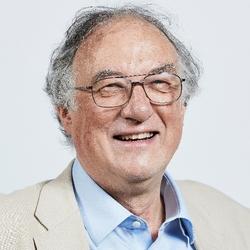

Biography
Chris Burgoyne graduated from St John's College, Cambridge. After taking a Master's degree at Imperial College and working in industry he returned to Imperial to study for a PhD where he worked on the buckling of beams and columns with Prof. Eric Brown. He was appointed to a Lectureship in the Concrete Structures section at Imperial, which led to a change of emphasis towards the behaviour of prestressed concrete structures. Since prestressing tendons are the most heavily stressed of all structural elements, typically operating at 70% of their strength, they were natural candidates for the application of very high strength fibres, such as aramids and carbon fibres. This has led to long-term studies of the strength, creep and durability properties of these fibres, as well as studies of their application to concrete structures, bridges and offshore. He maintains a continuing interest in general prestressed structures and also in the structural mechanics of bone. He has recently been involved in the SPICE geoengineering project, where the properties of fibres are essential for the design of the tether to link a balloon at a height of 20 km for the injection of particles into the stratosphere. Chris moved to Cambridge in 1989 and was appointed Reader in Concrete Structures in 1999. He was appointed Professor in 2015. He is a Fellow of the Institution of Structural Engineers and a Member of the Institution of Civil Engineers.
Research
- The mechanics of the debonding process when carbon fibre plates detach from concrete structures. It is our belief that this cannot be analysed using finite elements but must be tackled using fracture mechanics.
- We are studying the long-term properties of aramid fibres, with particular emphasis on the visco-elastic processes that govern strength, creep, relaxation, stress-rupture and strength retention. We have carried out extensive work on aramid fibres, such as Kevlar and Technora, and are currently applying those techniques to PBO.
- Working on the design of a tether suitable for anchoring a balloon at a height of 20 km for the purposes of geoengineering or telecommunications The tether will have to support itself over its whole length (which effectively excludes metals as they are too heavy), must not conduct electricity (we don't want a lightening conductor) and must also be able to resist the bursting stresses from liquids contained within the pipe.
- The interaction of trabecular and cortical bone, which we believe can be modelled using a "beam on elastic foundation" model with the cortical bone being the beam and the trabeculae being the foundation. We also believe that failure is governed by buckling criteria (i.e. stiffness) rather than stress criteria (i.e. strength).
Publications
- Burgoyne C.J., Cable design for continuous prestressed concrete bridges, Proc. Inst. Civ. Engrs (Awarded Howard Medal 1989), 85, 161-184, 1988.
- Burgoyne C.J., Automated design of concordant profiles, Proc. Inst. Civ. Engrs, 85, 333-352, 1988.
- Burgoyne C.J., Junction effects in St. Venant's torsional stiffness, Struct. Eng. 71/3, 47-53, 1993.
- Burgoyne C.J. and Brennan M.G., Exact Ilyushin Yield Surface, Int. J. Solids & Structures 30/8, 1113-1131, 1993.
- Burgoyne C.J., Should FRP tendons be bonded to Concrete? Chapter in Non-metallic reinforcement and prestressing, American Concrete Institute, SP-138, 367-380, 1993.
- Burgoyne C.J. and Brown E.H., Non-uniform elastic torsion. Int. Journ. Mech. Sci., 36/1, 23-38, 1994.
- Ibell T.J. and Burgoyne C.J., A Plasticity Analysis of Anchorage Zones. Magazine of Concrete Research, 46/166, 39-48, 1994.
- Amaniampong G. and Burgoyne C.J., Analysis of the tensile strength of parallel-lay ropes and bundles of parallel elements by probability theory. Journ. Solids & Structures, 32/24, 3573-3588, 1995.
- Lees J.M., Gruffydd-Jones B. and Burgoyne C.J., Expansive Cement Couplers - A means of pre-tensioning Fibre Reinforced Plastic Tendons, Construction and Building Materials, 9/6, 413-423, 1995.
- Denton S.R. and Burgoyne C.J., The assessment of reinforced concrete slabs and bridge decks, The Structural Engineer, 74/9, 147-152, 1996.
- Stratford T.J. and Burgoyne C.J., The Toppling of Hanging Beams, Int Journal of Solids and Structures,37/26, 3569-3589, 2000.
- Lees J.M. and Burgoyne C.J., Analysis of concrete beams with partially-bonded composite reinforcement, ACI Structural Journal, 97/2, 252-258, 2000.
- Burgoyne C.J., Rational Use of Advanced Composites in Concrete, Proc Inst. Civil Engrs, Structures and Buildings, 146, 253-262, August 2001. (Awarded Bill Curtin Medal by the Institution of Civil Engineers)
- Stratford T.J. and Burgoyne C.J., Crack-based analysis of concrete with brittle reinforcement, Magazine of Concrete Research, 54, 321-332, October 2002.
- Burgoyne C.J., Does FRP have an economic future?, Invited Keynote Paper, 4th Conf on Advanced Composite Materials in Bridges and Structures, Calgary, Alberta July 2004.
- Marfisi E., Burgoyne C.J., Amin M.H.G. and Hall L.D., The use of MRI to observe the fracture of concrete, Magazine of Concrete Research, 52, 111-121, March 2005.
- Mayhew P.M., Thomas C.D., Clement J.G., Loveridge N., Beck T.J., Bonfield W, Burgoyne C.J. and Reeve J., Relation between age, femoral neck cortical stability, and hip fracture risk, The Lancet, 366, 129-135, 9th July 2005.
A full list of publications is available
Teaching and Supervisions
Currently teaching
- IB elective on reinforced concrete
- 3D3 module on Structural materials (part)
- 4D7 module on Reinforced Concrete (part)
- 4D8 module on Prestressed Concrete (runs in alternate years)
Currently supervising Matt Causier on the SPICE project